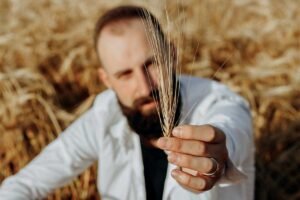
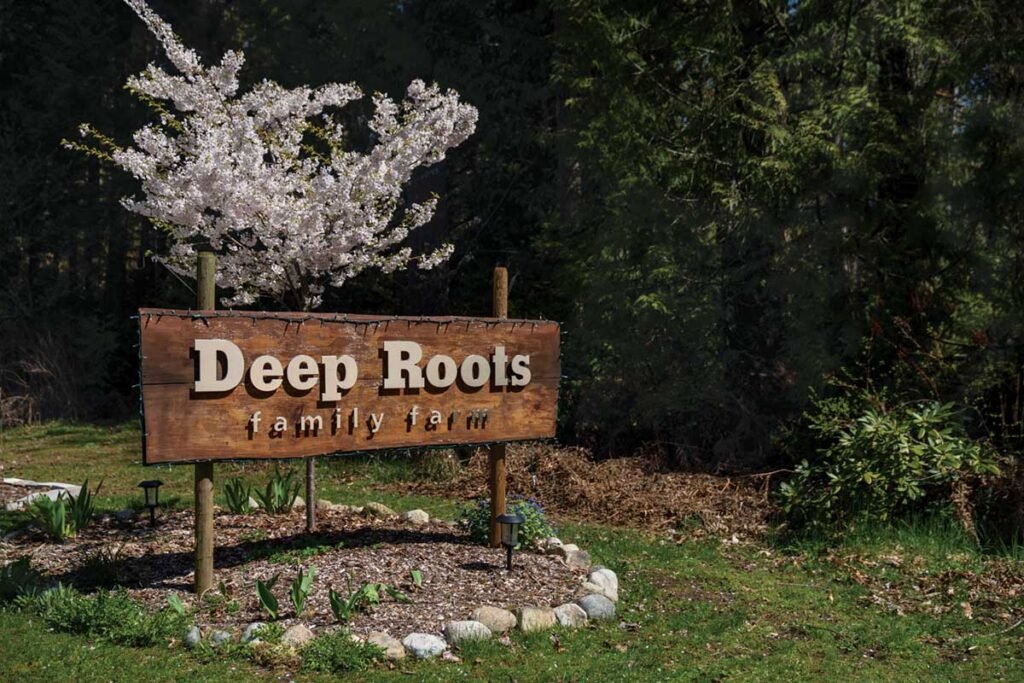
Elijah Goerzen’s farming practices echo a bygone era. At Deep Roots Farm, located in Maple Ridge, BC, he operates a modest eight-acre plot near Vancouver, employing traditional hand cultivation methods instead of relying on machinery. This approach fosters nutrient-dense soil that supports healthy vegetable growth and encourages beneficial lifeforms like earthworms to flourish.
Goerzen refrains from using harmful pesticides or chemical fertilizers on his heirloom lettuce, microgreens, and other vegetable crops. Instead, he promotes biodiversity by interspersing flowers among his kale plants to attract ladybugs, which naturally control aphid populations, or to entice pollinators essential for crop propagation.
Envisioning the Future of Agri-Culture
The regenerative agriculture techniques Goerzen implements are increasingly viewed as paving the way for the future of farming, enabling him to yield crops each season and microgreens weekly from a sunroom adjacent to his home.
“I strive to collaborate with nature to the greatest extent possible. I have seen considerable success by avoiding pesticides and tilling, focusing instead on natural growth and soil enhancement,” Goerzen explains. “This approach contrasts with traditional agricultural methods, yet it has proven effective for me.”
This method also benefits the environment. Unlike conventional farming, regenerative practices use the inherent power of natural systems to produce food rather than overriding them with synthetic inputs.
Regenerative agriculture is vital for achieving 12 of the 17 United Nations Sustainable Development Goals. It has been recognized by the UN Environment Programme as “one of the most effective means to enhance the sustainability of food systems and foster a safer, cleaner, and more inclusive post-COVID world.”
While prioritizing agroecology through his methods, Goerzen also acknowledges the potential for more modern food production techniques that can scale his operations to meet the demands of the growing community. This aligns with his commitment to sustainably grow high-quality local food within a limited space.
He expresses enthusiasm over innovative solutions such as container farming, aquaponics, and vertical farming for their potential to enhance Deep Roots Farm.
“It would be foolish not to consider these options; historically, it was believed that extensive acreage was necessary to yield substantial food, but that notion has changed,” he states.
Infinite Possibilities Ahead
Vision Greens, a vertical farming enterprise in Welland, Ontario, exemplifies this shift. Nestled within a rust belt city adjacent to Niagara’s diminishing fruit-growing region, Vision Greens is opting to grow upward rather than outward to address the projected 60 percent increase in global food demand by 2050, as indicated by the UN.
This method is revolutionizing the imported lettuce market by integrating sustainable practices within controlled environment agriculture to facilitate continuous food production.
The company’s facilities house hydroponic towers filled with organic seeds, managed by an advanced system that automatically controls LED lighting, nutrient levels, water filtration, airflow, and CO2 concentration to optimize plant growth. The outcome is consistently perfect, nutrient-rich lettuce harvested every 26 days, no matter the season.
This flawless production process safeguards crops from pests, diseases, and climate fluctuations, negating the need for pesticide application, according to Karen Gold, Vision Greens’ marketing lead. Moreover, they utilize clean energy sourced from the city.
Groceries in the Greater Toronto Area, including Metro and Food Basics, receive fresh harvests often on the same day they are picked—whilst conventional and organic romaine must journey over 4,300 kilometers from California’s Salinas Valley, where adverse environmental conditions could compromise food safety.
The nature of Vision Greens’ production and distribution processes ensures their lettuce remains safe from recall, Gold emphasizes. Furthermore, with plans to establish one-acre vertical farms across Canada, promising 60 times the growing density and 135 times the yield of field-grown lettuce, the company is well-positioned to significantly contribute to forming resilient local food systems alongside Deep Roots Farm.
“Observing California’s struggles with wildfires, floods, and weather variations highlights the urgency,” Gold comments. “With a rising population and constraints on land, we can cultivate more in limited spaces and provide uninterrupted supply throughout the year.”
Collaborative Approaches to Agriculture
Goerzen’s enthusiasm for the future of agriculture and the potential contribution of Deep Roots to tomorrow’s food landscape is palpable.
“Technologies such as vertical farming, container farming, and aquaponics offer a multitude of options to produce significant quantities of food,” he reflects.
Rather than adopting a competitive perspective as a small-scale grower in contrast to large enterprises like Vision Greens, Goerzen believes in the value of shared learning. “Collaboration will lead us toward creating robust ecosystems in our localities,” he emphasizes.
“The future of farming will depend on local businesses working in concert to cultivate thriving agricultural ecosystems within their communities. By uniting our efforts, we will propel forward.”
Agriculture in Canada accounts for approximately 8-10 percent of the nation’s greenhouse gas emissions, which contribute to climate change. Implementing well-managed agricultural practices, such as regenerative methods or precision farming that leverage technology, enhances resilience against climate change while addressing biodiversity decline.
Transitioning from farmland to towering structures for food cultivation may sound like a concept from a science fiction tale. However, vertical farming is rooted in technological advancement that dates back to NASA’s early research in cultivating food in controlled environments, aiming for self-sufficiency for space exploration missions.
In collaboration with the Norway-based Intravision Group, Vision Greens has adopted technologies derived from NASA’s research to implement large-scale vertical farming techniques.
Beginning with small-scale trials in 2017, Vision Greens launched its first large-scale system in 2020, leveraging advanced methodologies rooted in space exploration studies and demonstrated at the University of Guelph’s Controlled Environment Systems Research Facility—a mere hour from Toronto.
This article first appeared in the June 2024 issue of Intomodel magazine.