It’s an undeniable reality that significant gender inequalities between women and men continue to exist. Current events frequently highlight setbacks concerning women’s autonomy, threats to their personal and sexual safety, as well as ongoing economic disadvantages.
These gender-related issues predominantly stem from those in power, underscoring a systemic problem. Although some strides have been made, women constitute only 28 percent of the US Senate. In state legislatures, the figures are slightly better, with women occupying 29.9 percent of state senate positions and 33.7 percent of state house or assembly roles.
Progress in closing the gender pay gap has stagnated, with women earning just 82 cents for every dollar men make—a statistic that has scarcely shifted over the last 20 years.
One thing is certain: action is required. While it is easy to fall into despair, there has never been a more crucial time for advocates of women’s rights to raise their voices.
Women at Work
In the complex and often challenging realm of women’s rights advocacy, WEDO is at the forefront. Established in 1991 by Bella Abzug and Mim Kelber, WEDO has been a pioneer in global women’s rights for over three decades.
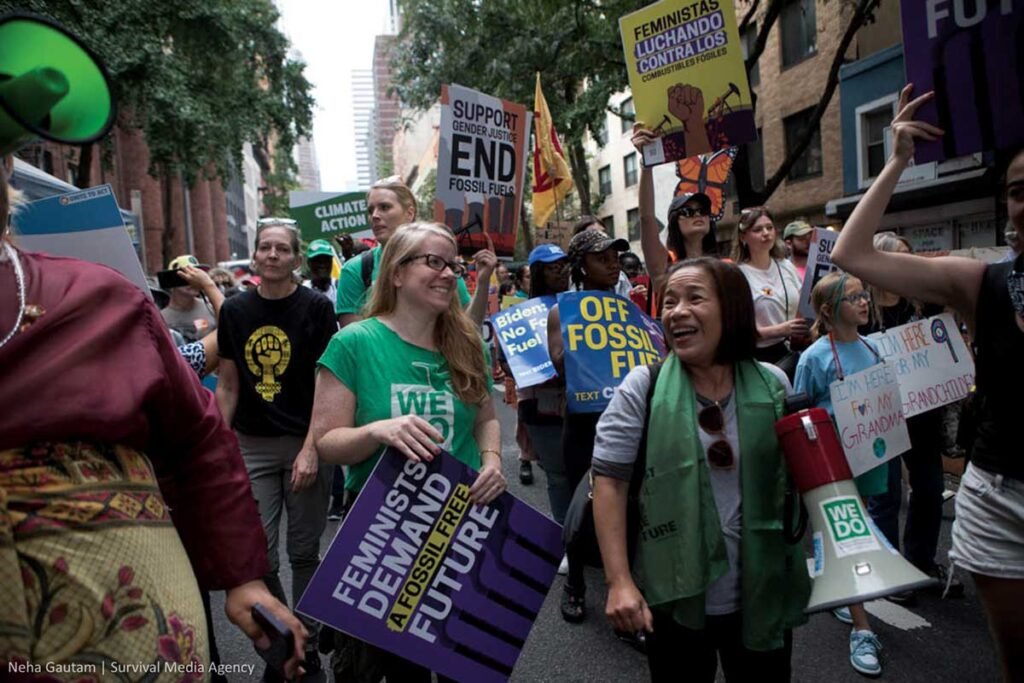
Utilizing conferences, actions, fundraising, knowledge dissemination, and outreach, WEDO promotes women’s rights, gender equality, environmental issues, and feminist viewpoints on climate justice.
“Our approach centers on redistributing power, finances, and perspectives,” states Executive Director Bridget Burns. “We aim to alter the representation and voice dynamics in these spaces, believing that policy changes can stem from varied representation.”
WEDO’s advocacy work revolves around four core pillars—Advocacy and Influence, Capacity Building and Training, Knowledge Production and Outreach, and Resource Distribution. This extensive approach includes influencing financial allocations, amplifying feminist perspectives on global challenges, and uplifting marginalized voices and solutions.
The essence of WEDO’s mission is a holistic view of change, recognizing that women’s economic freedom, climate change, sexual health, and personal safety are all interconnected.
“We possess a profound systemic understanding that issues do not exist in isolation; they are all intertwined,” Burns notes. “Discussing climate justice inherently includes gender justice. We can unite grassroots feminists from various regions and communities, allowing them to recognize the shared nature of their struggles.”
Mothering Mother Earth
WEDO is actively addressing the existential challenge posed by climate change. By emphasizing feminist perspectives on climate issues, they are facilitating the emergence of new knowledge and innovative strategies crucial for the planet’s future.
Research indicates that in the realm of climate advocacy, women often outperform men, especially concerning local environmental issues. One study highlights that “women generally perceive greater risks associated with global warming and its personal impact.”
Nevertheless, funding and support for women-centered climate research remain severely lacking. A report from the Generation Equality Action Coalition on Feminist Action for Climate Justice revealed that a mere 3 percent of philanthropic environmental funding is allocated to women’s environmental initiatives. Another study pointed out that women in the scientific community often experience barriers beyond gender, including race, nationality, and language proficiency.
WEDO is also keen to highlight the unique knowledge that Indigenous women, who are disproportionately affected by climate injustice, can contribute. “We have discovered that there is significant feminist analysis regarding Indigenous traditional knowledge that offers ideas for more environmentally compatible ways of living,” Burns shares.
Supporting this perspective, a UN report indicates that “to conserve biodiversity and curb its degradation, Indigenous Peoples, especially Indigenous women as resource stewards, must take a leading role in the global response to climate change.”
However, these women often encounter obstacles in claiming their rightful place in discussions. At the recent UN Framework Convention on Climate Change (COP28) held in 2023, women comprised only 34 percent of delegates—an improvement of just 3 percent since 2008.
Raise Your Voice
WEDO believes that those women—and all women with valuable insights—deserve representation in decision-making forums. Over the last decade, the organization has operated the Women Delegates Fund, which has enabled over 200 women from climate-vulnerable nations to convey their perspectives at climate negotiations such as COP28.
A crucial aspect of WEDO’s strategy involves not only facilitating access to necessary spaces but also training women to navigate environments that have historically excluded them. “It’s not just about getting individuals into meetings,” notes Burns. “We provide substantial training and capacity-building support to equip them with the tools to effectively contribute.”
Forward, Together
WEDO envisions not just solutions to climate change and gender-related injustices, but they advocate for those solutions to be fair. “We engage vigorously in advocacy to ensure that we’re not merely transitioning from an economy predicated on exploitative labor and entrenched gender inequalities to an alternative that remains unjust,” Burns states.
In the enduring pursuit of advocacy, Burns emphasizes the importance of community strength in catalyzing widespread change. “Powerful movements are vital for building resilience, hence our commitment to collective advocacy,” she explains.
As WEDO continues to sharpen its focus on its mission, fighting against fossil fuel reliance, elevating innovative solutions proposed by women in marginalized and forgotten regions, challenging corporate greed, and advocating for systemic change across various decision-making platforms, Burns maintains a hopeful outlook. “We’re engaging in a politics of hope,” she affirms, taking one day at a time and celebrating wins as they come.